Showing posts with label best1. Show all posts

Saturday, November 10, 2018

Word from Mythology: HYPNOTIC

The English word hypnotic (and related words like hypnosis and hypnotize) come from the Greek language originally (the "y" is a good clue about that!), specifically from the Greek word hypnos which means "sleep" (ὕπνος). When something is hypnotic, that means it puts you into a state like that of sleep. In a medical context, like a "hypnotic drug," that means the drug is sleep-inducing.

Hypnos was also personified as the God of Sleep. His mother is "Night" and his father is "Darkness," and his brother is Thanatos, "Death." You can read more about the Greek god at Wikipedia.

Here is a bronze head of Hypnos, circa 100 C.E.:


Sunday, November 4, 2018

Word from Mythology: Museum

The word MUSEUM comes to use from the Greek Muses, the goddesses of art and knowledge. Our word is a borrowing of the Latin word museum, which in turn comes from the Greek word mouseion, meaning a shrine of the Muses. You can see a list of the nine Muses and their special gifts in this Wikipedia article.

Below is Hendrick van Balen's painting of Minerva (Athena) and the Nine Muses:


Friday, October 12, 2018

Word from Mythology: Volcano

The word "volcano" comes from the name of the Roman god Vulcan (equivalent to the Greek god Hephaistos). Vulcan was the god of fire and metallurgy, and Mount Etna was Vulcan's forge.

Vulcan is also the name of a planet in the world of Star Trek, with Mister Spock being the most famous of the Vulcan characters.

Below is a painting of Vulcan by Andrea Mantegna:


Saturday, September 22, 2018

Word from Mythology: Narcissicist

I've written here already about the Greek nymph Echo who gives us the English word "echo," and now I need to add Narcissus, the Greek mythological character who gives us the word "narcissicist" and "narcissicism" in English. As you can read in the Wikipedia article, Narcissus spurned the love of others (including the love of Echo), but he fell in love with his own reflection in a pool of water. Refusing to leave, he wasted away and finally died there, entranced by his own image.

This ancient story led Freud to coin the term "narcissicim" to refer to someone who is self-obsessed; you can read more about the psychological dimensions of narcissicism at Wikipedia.

Narcissus also gave his name to the flower "narcissus," also known as "daffodil." Ovid, in his Metamorphoses, tells us that after he died, Narcissus was turned into a daffodil. You can read Ovid's version of the story at Tony Kline's website: Ovid's Metamorphoses in English.

Here is a medieval depiction from the British Library's Harley 1766 ms.


Here is a modern illustration by Franceschini:


Wednesday, September 19, 2018

Word from Mythology: Draconian

Today's word from mythology is "draconian," which means laws that are especially strict or severe, and more generally it can refer to anything which is extremely severe. The word comes a proper name, Draco, who was the first lawgiver of Athens in the 7th century B.C.E. At the time, the law of Athens was an oral code, and Draco replaced it with a written code. Draco's laws were notoriously harsh and were later repealed by Solon; you can read more about Draco and his laws at Wikipedia.


Carving of Draco Lawgiver
in the United States Supreme Court.

Tuesday, September 4, 2018

Word from Mythology: Morphine

The name of the drug morphine takes its name from the Greek god Morpheus, the god of dreams and the illusions we see in sleep; his father is Somnus, the god of sleep. Friedrich Sertürner, a German pharmacist, isolated morphine around the year 1805 (it became commercially available in 1827), and he named it after Morpheus because the drug was sleep-inducing. You can read more at Wikipedia, and you can also read about the etymology of heroin in this post: Heroine and Heroin.

The painting is a detail from a fresco by Luca Giordano showing Morpheus and Night:


Saturday, September 1, 2018

Word from Mythology: Mentor

The word "mentor" is widely used in English now, but most people do not know that this is a name from Greek mythology: Mentor. Mentor was a friend of the Greek hero Odysseus, and he also advised Odysseus's son Telemachus. When the goddess Athena wanted to advise Telemachus, she disguised herself as Mentor.

The use of the word "mentor" in English to mean an "advisor" dates to the 18th century. Nowadays you can also hear the word "mentee," which is formed as if "mentor" were a Latin verb, but that is a bit of linguistic nonsense that does not fit the Greek origins of the word at all! The word "mentee" was coined in the 1960s. To fit the Greek, it would be better to talk about a "mentor" and a "telemachus," rather than mentor and mentee. :-)

You can read more about Greek Mentor at Wikipedia, which is also the source for this picture of Mentor with Telemachus:


Monday, August 27, 2018

Words from Mythology: SYRINGE

The "y" in the word "syringe" is a clue that it comes from Greek. To be specific, English "syringe" comes from Greek syrinx, which refers to a tube or pipe, including a musical pipe. The word has a story that goes with it: Syrinx (Σύριγξ) was a nymph devoted to Artemis, the virgin goddess of the woods and forest. The god of the woods, Pan, lusted for Syrinx and pursued her; in order to escape, Syrinx prayed to be turned into reeds by the water's edge. Pan cut the reeds and shaped them into a "Pan's pipe," hence the meaning of the word syrinx, "pipe." You can read more about the nymph Syrinx and her story at Wikipedia.


You can also read more about pan pipes at Wikipedia. Here is a fourth-century mosaic of a shepherd with pan pipes:


Saturday, August 11, 2018

Word from Mythology: Chaos

The word from mythology today is CHAOS, which is a Greek word borrowed into English; the ch- in the spelling is a clue. The Greek word is khaos, χάος. In the ancient Greek story of creation, the world originally was "chaos," a void without form or shape, literally the "gap" between heaven and earth at the beginning of creation. In some of the ancient Greek writers, Chaos was one of the most primitive of the gods, along with Gaia (the earth), Tartarus (the underworld), and Eros (love).

Later on, the word chaos came to refer to a mixture of elements that had not yet taken shape in the process of creation, hence our modern sense of things being "chaotic."

The image below is the depiction of "Magnum Chaos," The Great Chaos, as designed by Lorenzo Lotto for the Basilica of Santa Maria Maggiore in Bergamo, Italy.


Sunday, February 11, 2018

Word from Mythology: Siren

The word "siren" comes from the Greek monsters called Sirens, dangerous female creatures whose mysterious song lured sailors to their doom. You can read more about Sirens in this Wikipedia article. The use of "siren" to mean a warning sound or alarm is fairly modern, dating to the late 19th century.

We learn about the Sirens in Homer's Odyssey, when the hero Odysseus wants to hear the Sirens' song. He orders his men to fill their ears with wax so that they will be immune to the Sirens' power, and they then tie him to the mast of the ship. When Odysseus hears the song, he wants to jump off the ship and swim to the Sirens' island, but he is unable to break free of the ropes binding him to the mast. You can see that story illustrated in this 2nd-century mosaic:


Wednesday, February 7, 2018

Word from Mythology: Geology

Today's mythology word is geology, which comes from the name of the Greek goddess Gaia, which is also the Greek word for the earth herself. To learn more about Gaia, see Wikipedia.

There are many more words formed from this same Greek root: geography, geode, geodesic, geometry, geopolitcal, etc. The name "George" also contains the same root: "George" is from the Greek word georgos, "farmer," someone who works the earth (geo-ergos).

This is a statue of Gaia in Lysá nad Labem (Czech Republic).


Monday, January 29, 2018

Word from Mythology: Cereal

Today's word from mythology, cereal, comes from the name of the Roman goddess of agriculture, Ceres, called Demeter by the Greeks. In the Roman religious calendar, her festival, the Cerealia, was celebrated on April 10. You can read more about Ceres/Demeter at Wikipedia.

The use of the word "cereal" to refer to breakfast cereal is an American usage dating to 1899.

This vase painting of Demeter dates to the 4th century B.C.E.


Wednesday, January 17, 2018

Word from Mythology: Atlas

The English word atlas refers to a book that contains maps, and it got its name from the Greek Titan god, Atlas. You can read more about Atlas at Wikipedia.

The use of "atlas" in English to mean a collection of maps dates to 1636 when an English translation was published of Gerhardus Mercator's Atlas, sive cosmographicae meditationes de fabrica mundi ("Atlas, or cosmographical meditation on the construction of the world"), first published in 1585.

Mercator chose the title Atlas for his book because of the legend that Atlas holds up the pillars of the heavens, his punishment for having fought against Zeus and the Olympian gods in the battle called the Titanomachy.

The statue below shows the Farnese Atlas; more at Wikipedia:


This is a statue of Atlas on the Schloss Linderhof:


Monday, January 15, 2018

Word from Mythology: Chimera

The English word chimera is from the Greek chimaera (khimaira), a fire-breathing mythical beast that had the head of a lion, the body of a goat and the tail of a serpent. You can read more about the chimera at Wikipedia.

In English, the word has come to mean something so weird or fantastical that it cannot possibly exist, an illusion.

The image below shows the famous "Chimera of Arezzo," a bronze statue dating to around the year 400 B.C.E.


Friday, January 12, 2018

Word from Mythology: Labyrinth

The English word labyrinth is from the Greek word labyrinthos, which means a maze with winding passages. In Greek mythology, Daedalus built a labyrinth for King Minos of Crete in which to imprison the Minotaur. You can read more about labyrinths at Wikipedia.

This Roman mosaic shows the hero Theseus slaying the Minotaur inside the labyrinth:


Tuesday, December 26, 2017

Word from Mythology: Titanic

The English word titanic, meaning "enormous, exceptionally strong, massive," comes from the name of the Greek gods called Titans, the children of Gaia (Earth) and Uranus (Sky). The Titans were gigantic in size and incredibly strong; they ruled the world until they were overthrown by Zeus and the Olympian gods and imprisoned in Tartarus. Two of the most famous Titans are Atlas and Prometheus. You can read more about the Titans at Wikipedia.

The word "titanic" acquired a new, and ironic, meaning as Titanic, the name of the enormous ocean liner which hit an iceberg and sank in 1912, a disaster in which more than 1500 people died. You can read more about the Titanic at Wikipedia.

The image below is an illustration by Gustave Doré of Dante's Inferno; it shows the Titans chained in the underworld:


Sunday, December 24, 2017

Word from Mythology: Aegis

Today's word from mythology is "aegis," which means "protection." You may have heard in the phrase "under the aegis of (someone or something)." The ancient Greek aegis was a special animal-skin shield; the goddess Athena had an aegis, and the god Zeus also had an aegis.

The word is related to the Greek word for "goat," and one legend tells that the aegis is from the skin of a pet goat which belonged to baby Zeus; later, Zeus used the shield made from the goat's skin in his battle against the Titans. You can read more about the legend of the aegis at Wikipedia.

Athena's aegis bore the image of the head of Medusa the Gorgon, as you can see in the image below, a statue of Athena by the sculptor Phidias:


Friday, October 20, 2017

Word from Mythology: Colossal

The English word colossal is from the Latin colossus, a word that is in turn borrowed from Greek kolossos. The Greek word meant a gigantic statue, originally the Colossus of Rhodes. The English word now refers to anything that is huge in size.

The Colossus of Rhodes was a gigantic statue of the Greek god Helios, one of the Titans. It was erected in the year 280 B.C.E. and was regarded as one of the Seven Wonders of the Ancient World. You can read more about the Colossus of Rhodes at Wikipedia.

The caption to the illustration below reads "The Colossus of Rhodes, a prodigious brass statue dedicated to the Sun, which, holding fire in its right hand, served for a sea light to ships; for lighting the fire there was a staircase (that) went through one of his legs, through the inside of the body and arm."


Wednesday, May 3, 2017

Word from Mythology: CORNUCOPIA

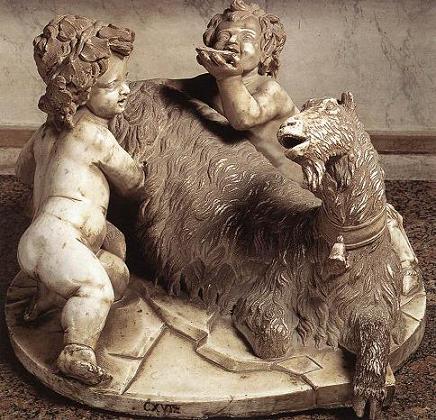
The word "cornucopia" is from Latin: cornu-copiae, horn (cornu) of plenty (copiae). This word is associated with a specific mythological character: Amalthea, the goat who nursed the infant Zeus.

The story goes that the Titan god Cronus feared that he would be overthrown by his son (as he, in turn, had overthrown his father Uranus). One by one, as his wife the goddess Rhea gave birth, he swallowed the children. When Zeus was born, Rhea hid him away on the island of Crete, and gave Cronus a rock wrapped up in swaddling clothes, and Cronus swallowed that rock instead. Amalthea, a goat goddess, was Zeus's foster mother, suckling him when he was a baby. You can read more about Amalthea at Wikipedia. Here is Bernini's sculpture of Amalthea:


This Greek vase shows the earth god Plouton holding the keras amaltheias, the "horn of Amalthea," together with the goddess of the harvest, Demeter:


You can read more about the cornucopia at Wikipedia. This Roman mosaic shows the personification of The Year, holding a cornucopia of prosperity:


Saturday, July 25, 2015

Word from Mythology: Hector

Last time I looked at how the Greek name "Mentor" became the English verb and noun, "mentor," and this time, you will see how the Greek name "Hector" becomes the English word "hector."

Hector was a prince of Troy and leader of the Trojan forces against the Greeks in the Trojan War. Homer's Iliad shows Hector having to shout at his troops, encouraging them to face their enemy bravely, and he also had to upbraid his cowardly brother Paris whose kidnapping of Helen precipitated the war. Hector's speeches led to the English verb "hector," which originally mean to shout, encourage, and domineer.

Over time, the English word "hector" has taken on negative connotations, meaning something like "to bluster, to bully," even though Hector is an entirely admirable character in the mythological tradition.

The painting below is "Hector Reproves Paris" by Richard Cook: